
Use case · Product & engineering
Blockchain data infrastructure for product and engineering teams, without the indexers
Every chain your product adds means another indexer, another decoder and another on-call rotation. SonarX takes all three off your roadmap.
SonarX delivers decoded, normalized on-chain data for 130+ chains into the stack you already run: your warehouse, your lake, your services. There are no nodes to operate and no pipelines to build, and nothing to stand up just to receive the data. SonarX is SOC 2 Type I and II and GDPR compliant.
At a glance
- Decision it supports
- Whether to keep building an indexer and decoder per chain, or move that work off your roadmap.
- Available now
- Decoded, normalized tables for 130+ chains, a REST API for point-in-time balances, Labels, blocks, transactions, logs, traces and transfers, Kafka streams in Avro that replay after a disconnect, decoded traces, and tables and streams for failed transactions and slashing. With a Snowflake share, Snowflake's MCP support and Cortex work on the tables under your own roles.
- By request
- Decoding of contracts you name, and chains not yet covered.
The indexer tax on your roadmap
Each chain encodes addresses, events and state its own way. A reorg corrupts a table at 3 a.m. Protocol upgrades break parsers without warning. Sales promises a client a new chain, and the data team quotes a quarter. Most teams that build in-house end up maintaining infrastructure that was never their product, while the features they were hired to ship wait.
What SonarX takes off your plate
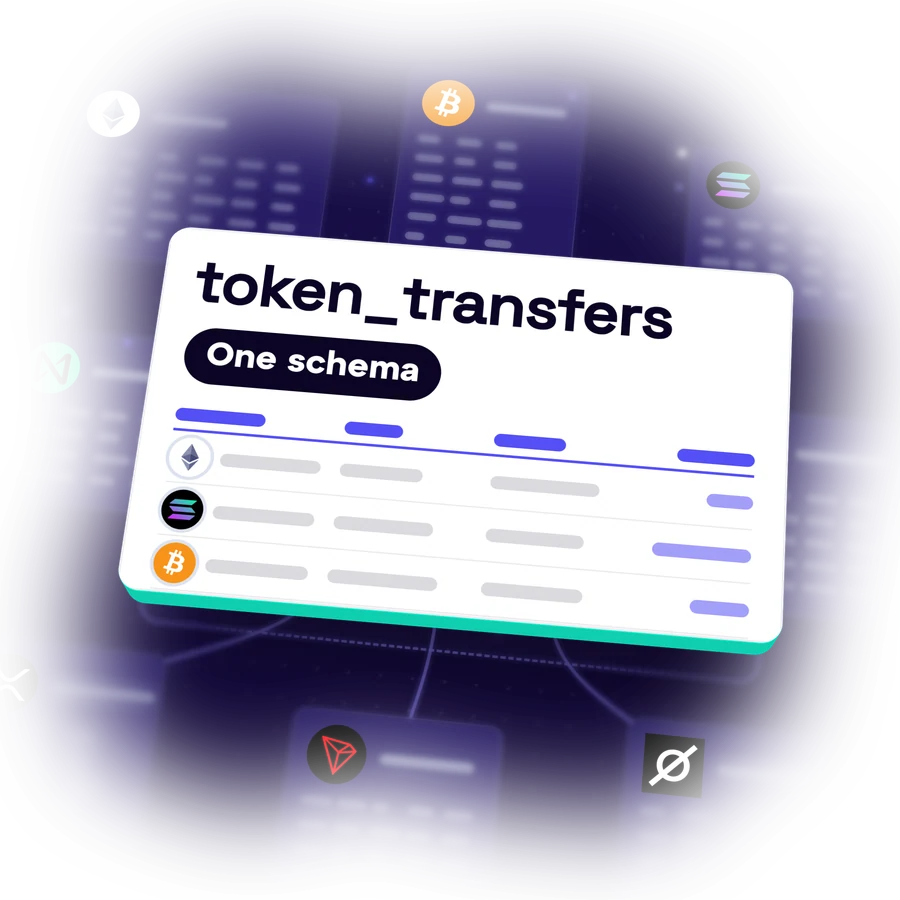
130+ chains in one schema
Blocks, transactions, logs, decoded events, traces, state diffs and transfers read the same way on every covered chain, as of October 2026.
Reorgs handled upstream
Genesis-to-tip history is reorg-aware and monitored by SonarX's Enterprise Data Quality Framework, so handling chain reorganisations stays SonarX's job.
Decoding on request, at no charge
If a contract your product needs is not decoded yet, the request is free. New chains go through Request a Chain.
Delivery in the shape of your stack
Warehouse shares, files in your bucket, a REST API or Kafka streams. Pick per workload.
A licence to build it into your product
Redistribution inside a product you sell is licensed per agreement, with per-chain packages available.
Worked example
Worked example: from data to decision
Suppose your team must decide whether to retire an in-house indexer for one chain.
Pull decoded, normalized tables for that chain and block range from SonarX, plus point-in-time balances from the REST API.
Compare them to your indexer output and classify each difference by cause. The comparison and its rules are customer-owned, and SonarX does not supply them packaged.
Take one mismatched row and confirm its chain, block and transaction on a public explorer.
The result feeds the decision to retire the indexer or keep it, and the engineering lead signs the migration plan.
The one-week trial below runs this same sequence on your own data.
Engineering jobs SonarX gets done
- Replace in-house indexing and decodingMost teams start here
- Ship customer-facing features on APIs and streams
- Run cross-chain analytics in SQL
- Give analysts and AI tools a way in
- Understand your users' on-chain behaviour
- Track protocol and chain adoption
- Audit contract behaviour and catch exploits
- Monitor network and protocol health
Most teams start with: Replace in-house indexing and decoding, Ship customer-facing features on APIs and streams and Run cross-chain analytics in SQL.
Most teams start here
Consume normalized, decoded data for every chain the business needs.
- Today
- One indexer per chain, one decoder per protocol, and a backlog of both.
- With SonarX
- Decoded, normalized tables for 130+ chains, maintained by SonarX.
- You get
- Engineers back on product work.
Who uses it: Data engineering leads, platform engineers, CTOs.
Power balances, transactions and portfolio views in your app.
- Today
- Self-hosted nodes and RPC providers stitched together per chain.
- With SonarX
- A REST API for point-in-time balances, blocks, transactions, logs, traces and transfers, plus Kafka streams in Avro that replay after a disconnect.
- You get
- Production data access with no nodes to run.
Who uses it: Backend engineers, product engineers.
Query many chains with one schema in the warehouse the team already uses.
- Today
- Per-chain tables with different column names and units.
- With SonarX
- One normalized schema in Snowflake or Databricks, with decoded protocol events and labels on request.
- You get
- Cross-chain queries without per-chain glue code.
Who uses it: Analytics engineers, data scientists.
Let analysts and internal AI tools query on-chain data without a bespoke integration.
- Today
- A custom connector per tool, or analysts who wait on engineering for every query.
- With SonarX
- With a Snowflake share, Snowflake's MCP support and Cortex work on SonarX tables in your own Snowflake account, under your own roles. Nothing SonarX-specific is needed, and SonarX never sees your prompts or queries.
- You get
- Natural-language and tool-based access on the same tables your engineers already query.
Who uses it: Analytics engineers, data scientists, analysts.
Join wallet activity to your own user records for segmentation and retention.
- Today
- Wallet data and product data live in separate systems.
- With SonarX
- Wallet histories and balances in your warehouse, ready to join to your records there.
- You get
- Cohorts and segments that include on-chain behaviour.
Who uses it: Product analysts, growth teams, data scientists.
Define and schedule usage, liquidity and growth metrics for a product or chain.
- Today
- Each metric needs a new pipeline.
- With SonarX
- Decoded activity, holders and liquidity per protocol and chain, queryable on a schedule you set.
- You get
- KPIs and anomaly alerts on your own definitions.
Who uses it: Ecosystem and growth teams at chains and protocols, product managers.
Reconstruct a contract's full interaction history and flag anomalous flows quickly.
- Today
- Trace data is missing on the chain that matters right after an incident.
- With SonarX
- Decoded traces and full interaction history, with streams for live monitoring.
- You get
- Inputs for audits, incident response and security products.
Who uses it: Security researchers, smart-contract auditors.
Watch congestion, failed transactions and slashing across chains.
- Today
- One monitoring script per network.
- With SonarX
- Streams and tables for failed transactions, slashing and network activity.
- You get
- One operational view across networks.
Who uses it: Site reliability engineers, validator operations, risk teams.
Most teams start with: Replace in-house indexing and decoding, Ship customer-facing features on APIs and streams and Run cross-chain analytics in SQL.
Engineering teams in these sectors build on SonarX: fintechs and wallets, compliance, security and forensics vendors, crypto accounting and tax software, chains, protocols and DAOs and market data providers. Related: publishing and distribution.
One-week trial
Prove it in your one-week trial
Pick one of your own indexed tables, query the same chain and block range in SonarX, and compare row counts and values to your in-house output.
Call the REST API for an address balance at a past block and compare it to the same address and block read from your own node or RPC provider.
Disconnect a Kafka consumer mid-stream, replay, and compare the replayed records to the same block range in the warehouse share.
How it arrives
Delivery options
- Warehouse
- Snowflake Secure Data Sharing, Databricks Delta Sharing, or a managed Reader account with SQL and no warehouse of your own.
- Files
- Parquet, CSV or Iceberg into your S3, Google Cloud Storage or Azure bucket.
- Services
- A REST API and Kafka streams.
Security review, ready
SonarX holds SOC 2 Type I and II and is GDPR compliant. See the Trust Center.
Engineering FAQ
How does SonarX handle chain reorganisations?
History is reorg-aware and monitored by the Enterprise Data Quality Framework. Corrections happen in SonarX's pipeline, so your tables follow the canonical chain without reorg logic in your code.
What happens when a contract is not decoded yet?
Request it through the standard channel. Contract decoding requests are free, and the decoded events then appear in the same schema as everything else.
Can we build SonarX data into a product we sell?
Yes, under a redistribution licence agreed per contract, with per-chain packages available. Your logic and your customers stay yours.
Do we need our own warehouse?
No. A managed Reader account gives a SQL workspace, and the REST API and Kafka streams serve applications directly.
How fast can we evaluate?
Minutes. Qualified teams get a one-week trial on a share, a Reader account or Kafka, and an API trial at one request per second.
Test it on your own chains
Delivered through Instant Datashares, Kafka Streaming, the Realtime API, Balances and Curated Datasets.