
Use case · Finance & operations
On-chain data for finance and operations: close, reconcile and report on 130+ chains
Month-end will not wait for a chain your data source skipped. SonarX ties every balance, transfer and reward in your ledger to a block, in the warehouse you already close from.
SonarX delivers high-quality on-chain data for 130+ chains into your Snowflake or Databricks account or your cloud bucket. There is no node to run, no pipeline to build and nothing new to stand up before finance can query it. SonarX is SOC 2 Type I and II and GDPR compliant.
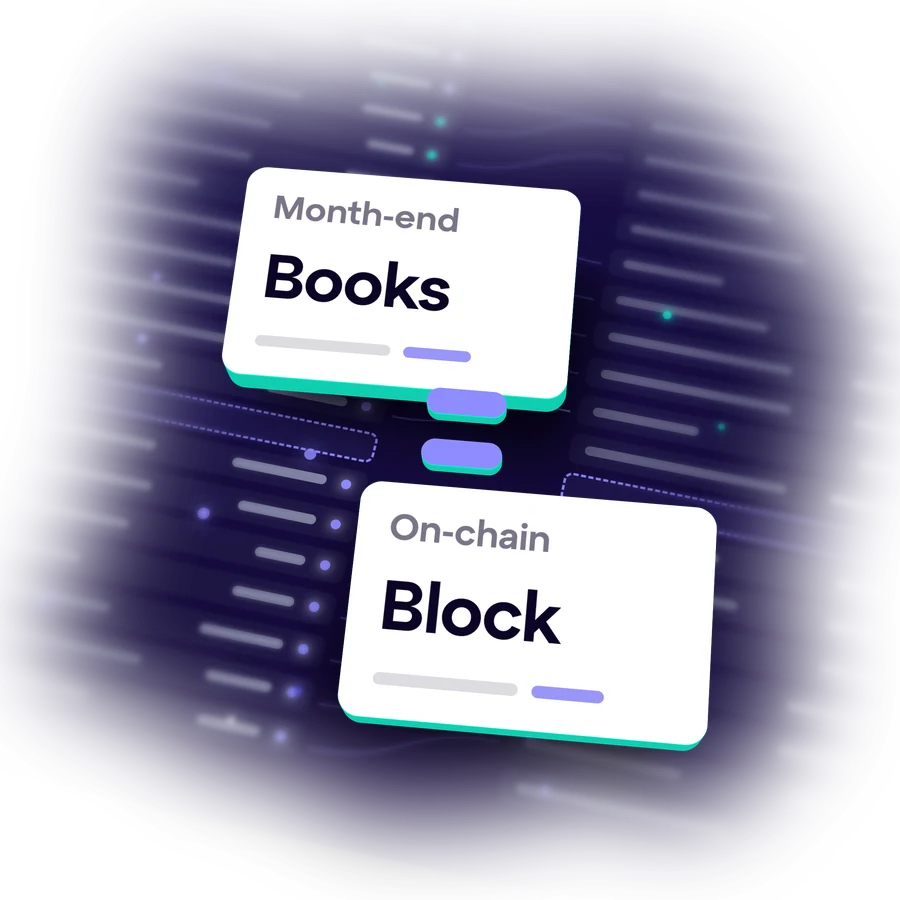
At a glance
- Decision it supports
- Whether a balance, transfer or staking figure in your close will reproduce when the auditor asks you to rebuild it.
- Available now
- Point-in-time and daily balances with state diffs, priced transfers, roll-forwards and fair-value tables, staking income ledgers on 10+ proof-of-stake chains, Labels, and treasury wallet streams with alerts on large or failed transfers.
- By request
- Decoding of contracts you name, and chains not yet covered.
Why does the crypto close still run on spreadsheets?
Your books hold assets on a dozen chains, each storing data its own way. An explorer gives you a number with no block height. Prices come from wherever the analyst found them. A reorg or a late reward moves a figure after sign-off, and the auditor asks you to rebuild it. Teams that try to fix this end up maintaining indexers instead of closing the books.
What SonarX changes for the close
Balances tied to a block
EVM balances by block height, Solana balances by snapshot, daily balance tables and state diffs for any record date. A balance comes with the block it was read at.
One schema for every chain you hold
130+ chains as of October 2026, decoded and normalized into one table layout. A chain SonarX does not cover yet can be requested, and contract decoding requests are free.
History that stays put
Genesis to tip, reorg-aware and checked by SonarX's Enterprise Data Quality Framework. A query rerun next year returns the same answer for a past date.
Tables built for accounting
Transfers priced at transaction time, fair-value tables, credit and debit roll-ups and staking income ledgers sit next to the raw chain data.
Your ledger never leaves your environment
You join SonarX data to the sub-ledger inside your own warehouse. SonarX never sees your queries.
Worked example
Worked example: from data to decision
Suppose a custodian statement and your sub-ledger disagree on one wallet at quarter end.
Pull the wallet's point-in-time balance at the period-end block from SonarX, with the priced transfers and roll-forward behind it.
Join those rows to your sub-ledger and your fund-to-wallet mapping, then classify each difference by cause under your close policy. This reconciliation step is customer-owned, and SonarX does not supply it packaged.
Take one transfer behind the break and look up its transaction hash on a public explorer to confirm the chain, block, amount and both addresses.
The reconciled balance goes into the close file, and the controller signs it off before it reaches the auditor.
The one-week trial below runs this same sequence on your own data.
Finance and operations jobs SonarX gets done
- Prove a balance at period endMost teams start here
- Reconcile custody and portfolio positions
- Recognize staking income in the right period
- Watch your own treasury wallets
- Reconcile stablecoin settlements
- Rebuild taxable events
- Report protocol financials from contract state
- Produce client statements
Most teams start with: Prove a balance at period end, Reconcile custody and portfolio positions and Recognize staking income in the right period.
Most teams start here
Show what any wallet held at the balance-sheet date, and reproduce it on request.
- Today
- Explorer screenshots per chain, with no block height and no way to rerun them.
- With SonarX
- One query returns the balance at the exact block or snapshot across chains, with every transfer behind it.
- You get
- Point-in-time balances, daily balances, state diffs and complete history.
Who uses it: Controllers, fund accountants, audit seniors.
Tie custodian and internal records to the chain, then value the positions.
- Today
- Three custodian exports, a price lookup table and a break nobody can explain.
- With SonarX
- Priced transfers, roll-forwards and fair-value tables land beside the raw chain data, ready to join to your records.
- You get
- Multi-chain position history valued at transaction time.
Who uses it: Custody operations, fund administrators, controllers.
Book rewards in the period they were earned and explain every commission.
- Today
- Validator dashboards disagree with custodian statements, and earned and claimed rewards get mixed.
- With SonarX
- Per-validator history of rewards earned and claimed, commissions and slashing on 10+ proof-of-stake chains, refreshed daily. Staking providers get validator APR, delegations and net stake flows from the same data.
- You get
- Staking income ledgers and validator analytics.
Who uses it: Fund accountants, staking operations leads, ETP finance teams.
Know every balance and movement in the wallets your organisation controls.
- Today
- One alert script per chain, and one of them fails without anyone noticing.
- With SonarX
- Balances and transfers for the wallets you name, with Kafka stream alerts on large or failed transfers.
- You get
- One operational view of treasury wallets across chains.
Who uses it: Treasurers, exchange and protocol finance teams.
Match every on-chain settlement to your ledger and catch the failed ones.
- Today
- Partner statements arrive late and finance re-keys them.
- With SonarX
- Transfers and balances for each settlement wallet as they happen, plus a daily file for finance, with failed and large transfers flagged.
- You get
- A settlement record finance can reconcile.
Who uses it: Payment operations, treasury, finance.
Feed a tax engine every disposal, swap and pool movement, priced when it happened.
- Today
- Exchange CSVs stitched to explorer pages, with gaps on long-tail chains.
- With SonarX
- Complete wallet histories with transfers and swaps priced at transaction time on every covered chain.
- You get
- Clean input for your tax engine.
Who uses it: Tax practitioners, tax software product teams..
Produce revenue and balance figures for a protocol from what its contracts recorded.
- Today
- Finance asks engineering for a new query each month, and definitions drift.
- With SonarX
- Decoded contract events, state and fee flows per contract, queryable in SQL.
- You get
- The inputs for a continuous P&L.
Who uses it: Protocol and DAO finance leads, foundation controllers.
Send clients statements that survive their own audit.
- Today
- Statements are rebuilt by hand each quarter from custodian exports.
- With SonarX
- Balance and activity schedules per client wallet, shaped to your layout, in Parquet or CSV.
- You get
- Statements you can reproduce for any past period.
Who uses it: Client reporting and custody operations teams.
Most teams start with: Prove a balance at period end, Reconcile custody and portfolio positions and Recognize staking income in the right period.
See these jobs in context for accounting, audit and tax firms, custodians, staking providers and validators, crypto accounting and tax software and payment networks. Related: payments analytics and token issuance.
One-week trial
Prove it in your one-week trial
Pick a wallet and a past period-end date, query its balance at that block or snapshot in SonarX, and compare it to your sub-ledger and to the same address on a public explorer.
Choose one validator and a closed period, pull rewards earned and claimed with commissions, and compare them to your custodian or staking provider statement.
Rerun the same period-end balance query later in the trial week and compare the result to your first run for the same past date.
How it arrives
How the data reaches finance
- Warehouse
- Snowflake Secure Data Sharing, Databricks Delta Sharing, or a managed Reader account that gives you a SQL workspace with no warehouse of your own.
- Files
- Parquet, CSV or Iceberg into your S3, Google Cloud Storage or Azure bucket.
- Live
- A REST API for point-in-time balances and Kafka streams for treasury and settlement systems.
Controls for your vendor-risk file
SonarX holds SOC 2 Type I and II and is GDPR compliant. Enterprise agreements cover all customer data. Details are in the Trust Center.
Questions finance and operations teams ask
Can we reconcile SonarX data against our own sub-ledger?
Yes. The data arrives in your warehouse or bucket, so you join it to sub-ledgers and custody statements without moving your own records. SonarX supplies the on-chain side, and your team keeps the mapping of wallets to funds and clients.
Will a balance we report today reproduce next year?
Yes. History runs from each chain's genesis, is reorg-aware and is checked by SonarX's Enterprise Data Quality Framework. A query for a past block or snapshot returns the same balance when an auditor or examiner asks you to rerun it.
Can we book fair value from SonarX prices?
SonarX prices transfers at transaction time and supplies fair-value tables as an input to your process. These prices are not a reference rate. Your valuation policy decides which price source goes into the books, and SonarX data shows the quantities and timing behind it.
Do we need our own data warehouse?
No. A managed Reader account gives finance a SQL workspace with the data already loaded. Teams with Snowflake or Databricks receive a share instead, and treasury systems can use the REST API or Kafka streams directly.
Which chains and staking networks are covered?
130+ chains as of October 2026, and staking data on 10+ proof-of-stake chains. If a client or fund holds a chain SonarX does not cover yet, send it through Request a Chain. Contract decoding requests are free.
Does SonarX see our wallets or our queries?
No. In a share into your own account, you query in your own environment and SonarX does not see your queries.
Test it on your own chains
Delivered through Instant Datashares, Kafka Streaming, the Realtime API, Balances and Curated Datasets.