
FAQ · Use cases by industry
What each industry uses on-chain data for
One answer per segment: the jobs teams like yours run on SonarX, and where each answer stops.
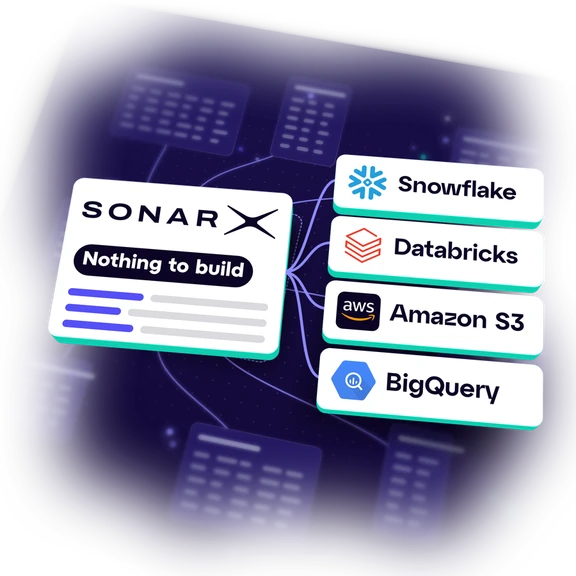
SonarX serves banks, auditors, exchanges, issuers, funds, payment firms, compliance vendors, staking providers, data providers, chains and researchers with the same 130+ chains (as of October 2026), delivered into their own warehouse with no infrastructure to build or run. Each answer below links to the segment page and to the use-case pages behind it.
The short answers
- One data foundation, many jobs
- The same 130+ chains (as of October 2026) serve banks, auditors, exchanges, issuers, funds, payment firms, compliance vendors, staking providers, data providers, chains and researchers.
- Where it lands
- In your own warehouse, with no infrastructure to build or run.
- Where it stops
- Wallet-to-client mapping and valuation judgments stay with you, and each answer below says so.
Banks, custodians and asset managers
What do banks and brokerages use on-chain data for?
Banks use it to reconcile the supply of a bank-issued token across chains, evidence custody holdings at a period end, reconcile stablecoin settlement and answer the MLRO on a suspicious flow. Data arrives in the bank's own warehouse, so client records never leave. Mapping wallets to client accounts stays with the bank. See banks and brokerages and finance and operations.
What do custodians use on-chain data for?
Custodians prove holdings for every client address at any block, reconcile the custody book daily with priced transfers and fair-value tables, and reconcile staking per client and per validator on 10+ chains. Client statements that cite the chain are prepared on request. See custodians and finance and operations.
What do asset managers and ETP issuers use on-chain data for?
Asset managers build NAV inputs from wallet balances, pay and evidence staking rewards inside an ETP, give their accountant independent holdings evidence and run research and systematic work on one history. The fund-to-wallet mapping and USD valuation of DeFi positions stay with fund operations. See asset managers and investment research.
Audit, payments and issuance
What do auditors, accountants and tax firms use on-chain data for?
Audit and tax teams test existence and completeness with point-in-time balances, reconcile custody records with priced transfers, verify staking income and trace funds for disputes. Tax histories are partial: lot methodology stays with the firm. The audit opinion stays with the firm too, and SonarX supplies the evidence. See accounting, audit and tax and finance and operations.
What do stablecoin and token issuers use on-chain data for?
Issuers reconcile circulating supply, mint and burn events and holder balances on every issuance chain for the monthly report, and watch treasury and bridge escrow wallets. Holder analysis and net circulating figures are prepared on request. Reserve assets are off-chain, and SonarX does not attest to them. See stablecoin issuers and issuance.
What do payment networks and PSPs use on-chain data for?
Payment teams reconcile settlement legs per wallet and chain, hold balances at cut-off for disputes and map corridors through labeled counterparties. Turnover, transfer count and transfer size separate payment-like flow from circular movement. See payment networks and payments.
Exchanges, funds and trading
What do exchanges and trading venues use on-chain data for?
Exchanges evidence what their own wallets held at period end, run treasury across hot, cold and omnibus wallets, list tokens on chains they have never indexed and trace hacks. Customer liabilities stay in the exchange ledger, and sanctions screening stays with the compliance vendor. See exchanges and trading venues and trading.
What do crypto funds and trading desks use on-chain data for?
Funds backtest on-chain factors on history from genesis, develop DEX strategies, monitor perpetual leverage and liquidations on Hyperliquid, and diligence tokens before investing. Exchange flows come through labeled deposit wallets, without an institutional or retail split. NAV inputs come from balances and priced transfers. See crypto funds and VCs and trading.
Data, compliance and network businesses
What do compliance, security and forensics vendors use on-chain data for?
These vendors add the chains their clients ask for without running nodes, trace funds across chains and bridges, monitor contracts for exploits in real time and embed licensed data in their own products. SonarX supplies the data layer; sanctions lists, risk scores and detection models stay with the vendor. See compliance and forensics vendors and market oversight.
What do staking providers and validators use on-chain data for?
Staking providers report rewards to institutional clients, benchmark validators, track stake flows and add networks they stake on but do not index. The staking dataset covers 10+ networks as of October 2026, with earned versus claimed rewards. See staking providers and finance and operations.
What do market-data, index and ratings providers use on-chain data for?
Data providers launch coverage of a new chain without a new pipeline, build index inputs with an audit trail, power staking-rate indices and license data into their terminals, feeds and APIs under agreement. Ratings teams get lending risk-parameter history from January 2026. See market data, index and ratings and publishing and distribution.
What do chains, L2s, protocols and DAOs use on-chain data for?
Chains put their data in every partner's warehouse, report ecosystem growth that holds up to scrutiny, watch foundation and DAO treasuries and give issuers on the chain the evidence they need. Protocol fee reporting uses decoded contract data. See chains, protocols and DAOs and product and engineering.
What do academic and policy researchers use on-chain data for?
Researchers publish citable empirical work, measure stablecoins as an economic indicator, study regulation and public chains and build factors for asset-pricing studies, all from genesis-to-tip history in one schema. Every row ties back to the chain, so results can be replicated. Market sizing by entity needs a labels request. See academic research and investment research.

Find the jobs that match your team
Tell SonarX your industry and the job you need done. The team maps it to the chains and tables that serve it, and scopes a one-week trial around it.
Delivered through Instant Datashares, Kafka Streaming, the Realtime API, Balances and Curated Datasets.