
FAQ · Pricing, trials & getting started
Pricing, trials and getting started with SonarX blockchain data
How plans are scoped, how a one-week trial runs, and what to bring so the week ends in a decision.
SonarX sells enterprise plans for 130+ chains (as of October 2026), delivered with no infrastructure for you to build or run. Qualified teams test on real data first. These answers explain what drives the price, how the trial works and how to get from first call to production.
The short answers
- Price
- Enterprise plans scoped to chains, datasets, history and delivery route. There is no public price list.
- Free tier
- None self-serve. Qualified teams get a one-week trial on real data, and sample data for five chains sits on AWS Open Data.
- Contract decoding
- Requests are free.
- First step
- Describe your scope on the contact page and the team returns a quote.
Plans and pricing
How much does SonarX cost?
SonarX sells enterprise plans, priced on the chains, datasets and delivery route you choose. There is no public price list, because a single-chain API project and a multi-chain warehouse share are very different. Describe your scope on the contact page and the SonarX team returns the best quote built on the chains and tables you actually need.
What drives the price?
Scope drives it: how many chains, which datasets (raw, decoded or curated, such as staking or DEX trades), how much history, and how the data arrives. API pricing tiers by request volume, requests per second, and latency. Redistribution rights, if your product needs them, are part of the agreement.
Is there a free tier?
SonarX has no self-serve free tier. Qualified teams get a one-week trial on real data instead, scoped to their own chains and questions, which tests far more than a capped free account would. For a first look without a conversation, SonarX also publishes sample data for five chains on AWS Open Data, updated daily.
Do you offer academic terms?
Yes. University and research teams can ask for academic terms when they apply. Researchers get the same 130+ chain history and normalized schema as enterprise customers, delivered through a share, files or a Reader account. Describe the study, the chains and the period you need, and the SonarX team scopes access around the research question. See academic research.
One-week trial
Test it on your own chains
Trials
How does the SonarX trial work?
Qualified teams get a one-week trial on a Snowflake share, a Reader account or Kafka, and a trial on the REST API at 1 request per second. SonarX agrees the chains and tables with you before it starts, so the week goes on your real questions rather than on setup. Apply through the trial form.
What should we bring to a trial?
Bring the chains and tokens in scope, two or three questions you must answer, and a sample of your own records to test against, such as a wallet list, a custody statement or a sub-ledger extract. Your records stay in your environment. Teams that test against answers they already know end the week with a clear yes or no.
What does a passing trial look like?
Write the test before day one and score it on day seven. Check scope (every chain, table and date range you named is present), reconciliation (a sample of your own records ties out and each figure traces to its transaction on a public explorer), historical completeness (your earliest date is present, with no gaps you can find) and freshness (you measure it against the chain yourself). Mark each pass or fail against a bar agreed in advance.
Can we test API performance during the trial?
The API trial runs at 1 request per second, enough to check coverage, fields and correctness on real wallets. It is not a load test. If throughput matters, describe your expected traffic and SonarX scopes the tier with you.
What happens after the trial?
You agree scope and terms, and SonarX moves you to production on the route you tested: a share, a Reader account, files, Kafka or the API, extended to the chains and history you contract for. Because the schema stays the same, queries and integrations built during the trial carry into production.
Getting started and support
How long does it take to get started?
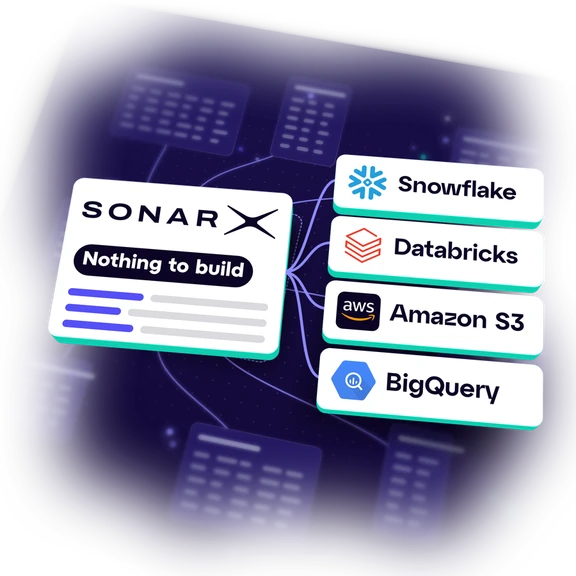
There is nothing for your team to build, so time to start depends on how fast you can move, not on engineering. A share or Reader account is granted in minutes, once chains and tables are agreed; files and streams only need your bucket or Kafka consumer details. SonarX confirms the date with you during scoping. See the delivery and integration FAQ.
Can we request a chain or a dataset before we sign?
Yes. Use Request a Chain for a new network, and send contract addresses for decoding, which SonarX does at no charge. Labels are available on request for any chain, and datasets such as tokens and payments, wallets and real-world assets are prepared on request. Raise them during scoping so the trial and the quote both reflect them.
Can we start small and add chains later?
You can. Start with the chains and datasets your first use case needs. Because every chain shares one normalized schema, adding chains later extends the queries you already run instead of opening a new integration. The agreement grows with the scope, and a chain SonarX does not cover yet can be requested at any point.
What support do we get?
Enterprise-level support is included at no extra charge and runs 24/7. Each customer works with the SonarX team on scoping, onboarding and data questions, and uses the support channel for decoding requests, chain requests and data issues.
Does pricing change if we redistribute the data?
Yes. Internal use, and charts you publish under your own name, need no redistribution rights. Putting SonarX rows or derived datasets into a product, feed or terminal for your clients is licensed per agreement, and SonarX also works through reseller agreements. Describe the product during scoping so the licence fits what your clients will receive.
Keep reading
More questions, by topic
Start with a one-week trial on your own chains
Tell SonarX your chains, your questions and the route your team uses. The trial is scoped with you before it starts.
Delivered through Instant Datashares, Kafka Streaming, the Realtime API, Balances and Curated Datasets.