
FAQ · Delivery & integration
Blockchain data delivery and integration: how SonarX reaches your stack
Pick the door your team already uses. There is nothing to build or run on your side.
SonarX runs the extraction, the indexing, the decoding and the quality checks. You receive 130+ chains (as of October 2026) as a warehouse share, a managed SQL workspace, files in your own bucket, Kafka streams or a REST API. These answers cover each route and how it meets your own data.
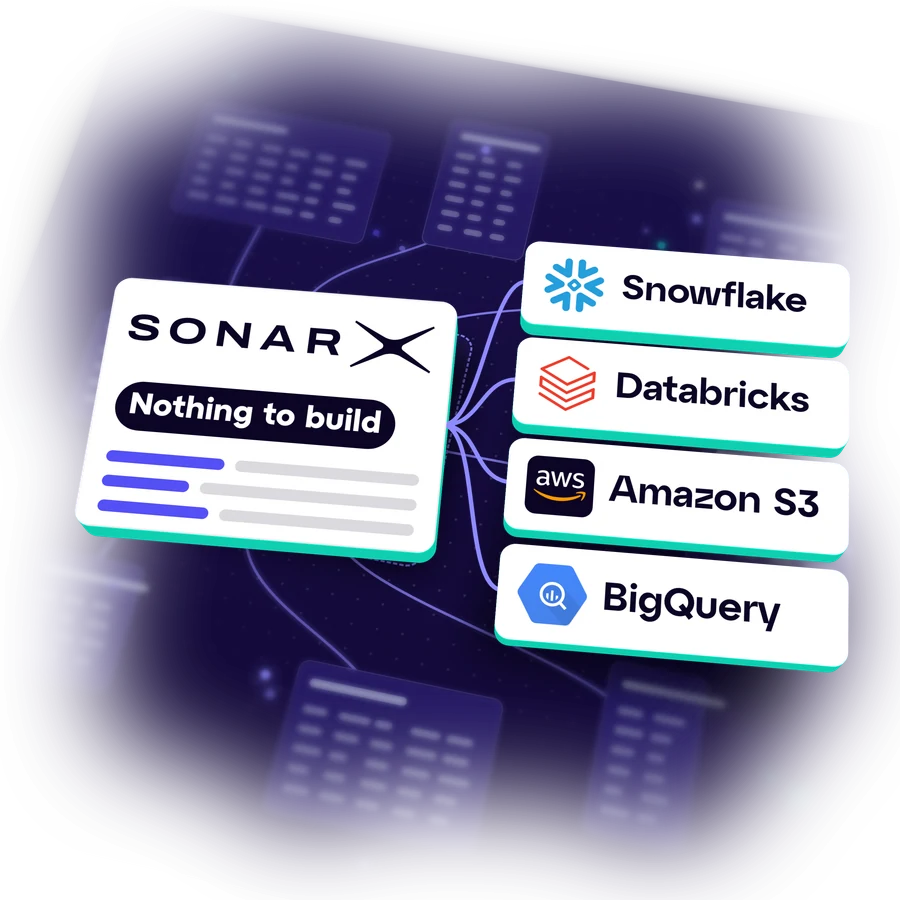
The short answers
- Routes
- Snowflake share (your account or a managed Reader account), Databricks Delta Sharing, files in your S3, GCS or Azure bucket, Kafka and a REST API.
- Infrastructure on your side
- None to build or run.
- Streams
- Kafka is live on all chains, upon request
- Test it
- A one-week trial on your own chains and your own delivery route.
Warehouses and files
Which warehouses and clouds can SonarX deliver to?
SonarX delivers through Snowflake Secure Data Sharing, into your own account or a managed Reader account, and through Databricks Delta Sharing. Files go to your AWS S3, Google Cloud Storage or Azure bucket as Parquet, CSV or Iceberg. If your team runs on BigQuery or another warehouse, ask SonarX about the current options for your cloud and region.
What is a Reader account?
A Reader account is a Snowflake workspace that SonarX manages for you, with the data already in it. Your analysts sign in and write SQL straight away, with no warehouse contract, cloud account or data engineer needed first. It suits teams that need answers before they need a platform, or a separate workspace for a sensitive project.
How it arrives
Four ways to receive the data
- Warehouse
- Snowflake Secure Data Sharing, into your own account or a managed Reader account, and Databricks Delta Sharing.
- Files
- Parquet, CSV or Iceberg in your AWS S3, Google Cloud Storage or Azure bucket.
- Streams
- Kafka streams carrying records in Avro, with replay and guaranteed delivery, on request.
- API
- Point-in-time balances on EVM chains plus Solana, and blocks, transactions, logs, traces and transfers.
Streams, APIs and AI access
Do you offer real-time streams?
Kafka streams are live today, carrying records in Avro, with replay and guaranteed delivery, on request. Teams use them for alerts on large or failed transfers, live balances, settlement monitoring and trading signals.
What does the REST API cover?
As of October 2026, the REST API returns point-in-time balances on EVM chains plus Solana, and blocks, transactions, logs, traces and transfers.
How fresh is the data?
Streams and the API deliver records shortly after a block reaches the chain tip. Shares and files refresh on a fixed cycle through the day, and lag is tracked per chain. Freshness of highest-quality historical core datasets varies between less than 10 minutes and up to 30 minutes for the most complex chains.
Can we use SonarX data with AI tools, MCP and Snowflake Cortex?
Yes. SonarX data arrives as tables in your own Snowflake account, so Snowflake's MCP support and Cortex work on it like any other table in that account, under your existing roles and permissions. Nothing SonarX-specific is needed, and the same applies to any AI tool your team has already approved for your warehouse. Tell SonarX which assistant you plan to use and the team will confirm it before you commit.
Fitting it into your environment
Do we need to build or run any infrastructure?
No. SonarX operates the ingestion, indexing, decoding and quality checks for every chain. A share or a Reader account needs no ingestion pipeline at all, files land in a bucket you already own, and Kafka and the API plug into services you already run. Nobody on your team has to keep a node in sync or repair a broken indexer.
Can we join on-chain data with our own data?
Yes, inside your own environment. A share sits next to your ledgers, custody statements, counterparty lists or KYC tables, so the join is ordinary SQL and your records never go to SonarX. SonarX supplies the on-chain side. Mapping wallets to clients, funds or accounts stays with your team, because only you hold that mapping.
How do we reconcile SonarX data with our internal records?
Join SonarX transfers and balances to your sub-ledger on transaction hash, address and block or date, then list the breaks. Because both sides sit in one warehouse, a reconciliation that used to live in a spreadsheet becomes a scheduled query your controllers rerun every period. Accounting-ready tables, such as priced transfers and credit and debit roll-ups, shorten the work.
Do our analysts need data engineers to use it?
Not for analysis. Analysts who write SQL query a share or a Reader account directly. Engineers come in when you build on the API or Kafka, or load files into your own lake. With Snowflake's out-of-the-box tools, connectors, and pre-integrations, your team charts the data in the BI tools it already licenses.
How long does it take to start?
With nothing to build, time to start depends on how fast you want to move. A share or Reader account can be granted within minutes, once chains and tables are agreed; files and streams only need your bucket or Kafka consumer details. Qualified teams begin with a one-week trial, and SonarX confirms the timeline with you during scoping. See pricing, trials and getting started.
Can we use the data inside our own product or app?
Yes, under a license that matches the use. Applications read through the REST API or Kafka, and data products often run from a share or files. Charts you publish under your own name need no extra rights; redistributing rows or derived datasets in a product, feed or terminal is licensed per agreement.
Choose a delivery route and test it for a week
Tell SonarX where your team works today. The trial runs on the same route you would use in production: a share, a Reader account or Kafka, with an API trial alongside.
Delivered through Instant Datashares, Kafka Streaming, the Realtime API, Balances and Curated Datasets.