
FAQ
Frequently asked questions
What buyers ask SonarX before they sign: which chains and history are covered, how the data reaches your stack, how plans and trials work, and how your work stays confidential.
- topics
- 5
- topics
- questions answered
- 64
- questions answered
- chains, one schema
- 130+
- chains, one schema
Coverage & data quality
Which chains, how much history, what is decoded, and how you can check it yourself.
All 14 questions →How many blockchains does SonarX cover?
SonarX covers 130+ chains as of October 2026, including Ethereum and the major EVM networks, Solana, Bitcoin, Sui, Aptos, Cosmos and TON. Every chain lands in one normalized schema, so blocks, transactions, logs, traces and transfers read the same way on each. The chain list shows what is live today, and Request a Chain covers the rest.
How far back does the history go?
History starts at genesis on every indexed chain and runs to the current tip. Some curated datasets start later: the lending tables begin on 1 January 2026, and DEX trade history depth varies by chain. Before a backtest or a multi-year study, ask SonarX for the start date of each table in your scope, so the sample period is the one you planned.
Can we get a wallet's balance at a past date or block?
Yes. On EVM chains you can read a balance at any block height, and Solana balances come as snapshots. Daily balance tables and state diffs let you rebuild holdings for a record date or a period end. For other chain families, confirm balance-history depth for the chains in your scope during scoping. Balances are priced at transaction time where a market price exists.
Do non-EVM chains use the same schema as Ethereum?
The core tables share one layout across chain families, so a query for transfers or blocks needs little change between Ethereum, Solana or Bitcoin. Fields that exist on only one family, such as Solana instructions or Bitcoin inputs and outputs, sit in additional columns or tables. The schema documentation lists them per chain, and SonarX walks your team through them during the trial.
Which protocols and markets are decoded?
Decoded event logs are standard on covered chains. Curated datasets add DeFi, staking, Hyperliquid and NFT sales, and tokens and payments; wallets and real-world assets are prepared on request. DEX trades include Uniswap v2, v3 and v4, Balancer, Raydium, Orca, Meteora, Phoenix, Aerodrome and SushiSwap, and lending covers 14 protocols on Ethereum. Coverage is constantly growing, so check the venue list with SonarX for the most up-to-date coverage and features.
Delivery & integration
Pick the door your team already uses. There is nothing to build or run on your side. These answers cover each route and how it meets your own data.
All 14 questions →Which warehouses and clouds can SonarX deliver to?
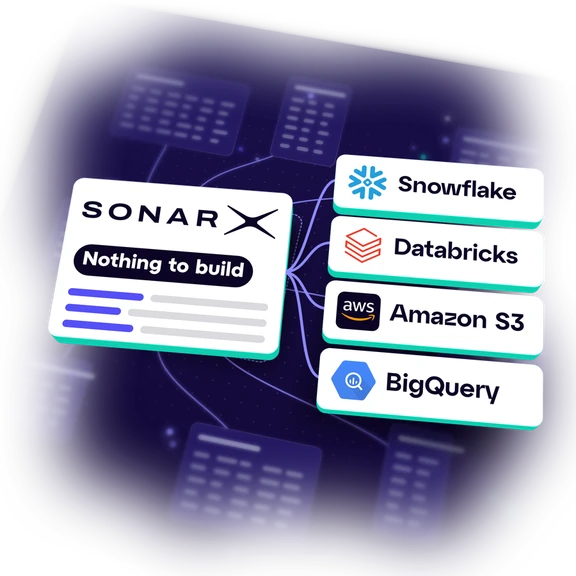
SonarX delivers through Snowflake Secure Data Sharing, into your own account or a managed Reader account, and through Databricks Delta Sharing. Files go to your AWS S3, Google Cloud Storage or Azure bucket as Parquet, CSV or Iceberg. If your team runs on BigQuery or another warehouse, ask SonarX about the current options for your cloud and region.
What is a Reader account?
A Reader account is a Snowflake workspace that SonarX manages for you, with the data already in it. Your analysts sign in and write SQL straight away, with no warehouse contract, cloud account or data engineer needed first. It suits teams that need answers before they need a platform, or a separate workspace for a sensitive project.
Do you offer real-time streams?
Kafka streams are live today, carrying records in Avro, with replay and guaranteed delivery, on request. Teams use them for alerts on large or failed transfers, live balances, settlement monitoring and trading signals.
Pricing, trials & getting started
How plans are scoped, how a one-week trial runs, and what to bring so the week ends in a decision. Qualified teams test on real data first.
All 14 questions →How much does SonarX cost?
SonarX sells enterprise plans, priced on the chains, datasets and delivery route you choose. There is no public price list, because a single-chain API project and a multi-chain warehouse share are very different. Describe your scope on the contact page and the SonarX team returns the best quote built on the chains and tables you actually need.
What drives the price?
Scope drives it: how many chains, which datasets (raw, decoded or curated, such as staking or DEX trades), how much history, and how the data arrives. API pricing tiers by request volume, requests per second, and latency. Redistribution rights, if your product needs them, are part of the agreement.
Is there a free tier?
SonarX has no self-serve free tier. Qualified teams get a one-week trial on real data instead, scoped to their own chains and questions, which tests far more than a capped free account would. For a first look without a conversation, SonarX also publishes sample data for five chains on AWS Open Data, updated daily.
Do you offer academic terms?
Yes. University and research teams can ask for academic terms when they apply. Researchers get the same 130+ chain history and normalized schema as enterprise customers, delivered through a share, files or a Reader account. Describe the study, the chains and the period you need, and the SonarX team scopes access around the research question. See academic research.
How does the SonarX trial work?
Qualified teams get a one-week trial on a Snowflake share, a Reader account or Kafka, and a trial on the REST API at 1 request per second. SonarX agrees the chains and tables with you before it starts, so the week goes on your real questions rather than on setup. Apply through the trial form.
Security, privacy & compliance
SonarX delivers 130+ chains (as of October 2026) into your own environment, with no infrastructure for you to build or run.
All 9 questions →Does SonarX have a SOC 2 report?
Yes. SonarX holds SOC 2 Type I and Type II reports. SOC 2 is an attestation by an independent auditor, so what your vendor-risk team needs is the report itself, which shows the controls tested over a period. Request it, with supporting security documentation, through the Trust Center.
Is SonarX GDPR compliant?
SonarX is GDPR compliant, as published in the Trust Center. The core data is public blockchain records: addresses, transactions and contract events. Using SonarX does not require you to send personal data, and any customer data you do share under the agreement is treated as confidential. Your data protection officer can review the privacy terms before signature.
Where do we find the subprocessor list and security documentation?
Request them through the Trust Center, which is where SonarX publishes its security and privacy posture for vendor-risk review. Ask there for the SOC 2 Type I and II report, the privacy terms and the current subprocessor list. Send your own security questionnaire through the same route, and the SonarX team returns it with the documentation attached.
Can SonarX see our queries?
No, not when you use a share. In Snowflake Secure Data Sharing and Databricks Delta Sharing, queries run in your account on your compute, so SonarX does not see what you query or what you join. The same holds for files delivered to your bucket. Client lists, trading research and investigation targets stay in your environment.
What does SonarX see when we use the API or streams?
API calls and stream connections reach SonarX servers, so SonarX can see which endpoints and addresses were requested, as any API provider can. That usage is customer data and stays confidential under your enterprise agreement. If a wallet list is sensitive, run that work in a share instead, where SonarX has no view of your queries.
Use cases by industry
One answer per segment: the jobs teams like yours run on SonarX, and where each answer stops.
All 13 questions →What do banks and brokerages use on-chain data for?
Banks use it to reconcile the supply of a bank-issued token across chains, evidence custody holdings at a period end, reconcile stablecoin settlement and answer the MLRO on a suspicious flow. Data arrives in the bank's own warehouse, so client records never leave. Mapping wallets to client accounts stays with the bank. See banks and brokerages and finance and operations.
What do custodians use on-chain data for?
Custodians prove holdings for every client address at any block, reconcile the custody book daily with priced transfers and fair-value tables, and reconcile staking per client and per validator on 10+ chains. Client statements that cite the chain are prepared on request. See custodians and finance and operations.
What do asset managers and ETP issuers use on-chain data for?
Asset managers build NAV inputs from wallet balances, pay and evidence staking rewards inside an ETP, give their accountant independent holdings evidence and run research and systematic work on one history. The fund-to-wallet mapping and USD valuation of DeFi positions stay with fund operations. See asset managers and investment research.
What do auditors, accountants and tax firms use on-chain data for?
Audit and tax teams test existence and completeness with point-in-time balances, reconcile custody records with priced transfers, verify staking income and trace funds for disputes. Tax histories are partial: lot methodology stays with the firm. The audit opinion stays with the firm too, and SonarX supplies the evidence. See accounting, audit and tax and finance and operations.
What do stablecoin and token issuers use on-chain data for?
Issuers reconcile circulating supply, mint and burn events and holder balances on every issuance chain for the monthly report, and watch treasury and bridge escrow wallets. Holder analysis and net circulating figures are prepared on request. Reserve assets are off-chain, and SonarX does not attest to them. See stablecoin issuers and issuance.
Trust
SonarX holds SOC 2 Type I and II and is GDPR compliant. Enterprise agreements cover all customer data. Reports and policies sit in the Trust Center.
Test it on your own chains