
Customers · Market infrastructure
On-chain data for CSDs, clearing houses, transfer agents and DLT venues
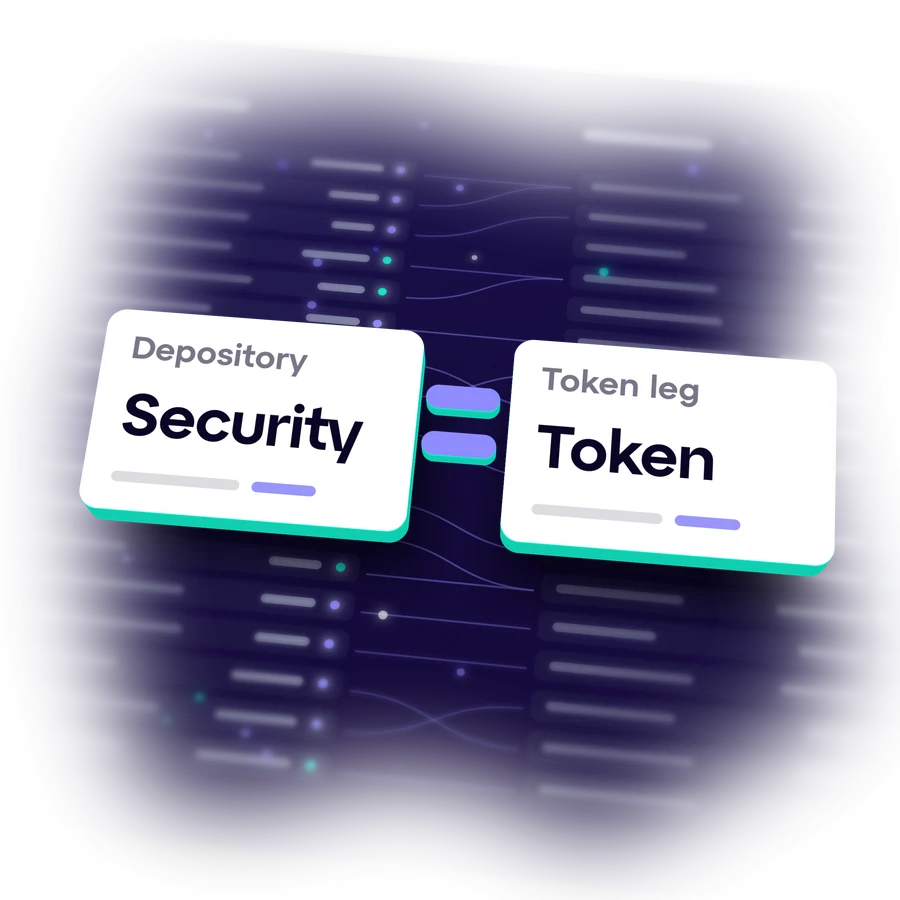
When a security exists at the depository and as a token on a public chain, someone reconciles the two every day. SonarX gives your operations team the chain side, tied to a block.
SonarX delivers high-quality data for 130+ public chains into the warehouse or storage you already govern. Your teams build and run no nodes, no indexers and no pipelines to produce or receive it.
At a glance
- Decision it supports
- Whether the public-chain leg of a dual-form security matches your book of record at the block that closes your business day.
- Available now
- Point-in-time balances by block on EVM chains and by snapshot on Solana, state diffs for any record date, real-time alerts on failed and large transfers with full transfer history, transactions, traces and bridge flows, and trades, streams, Labels and balances.
- By request
- Decoding of contracts you name, and chains not yet covered.
The problem you already know: the public leg sits outside your golden record
Most of your tokenization work runs on ledgers you operate. The public leg is different: a stablecoin settlement leg, a fund unit listed on an L2, a tokenized share trading on a public pool. Operations needs to know what settled, at which block, and whether a reorg could change it.
The transfer agent needs the on-chain holders at the record date to match the master securityholder file. Second-line risk wants an audit trail it can sample. Nobody wants to run Ethereum, Solana and L2 nodes to get there.
Where SonarX is different for market infrastructure
The public leg in one schema across 130+ chains
Blocks, transactions, logs, decoded events, traces and transfers share one layout. Adding a public rail adds a table filter, never a new indexer.
Every row tied to a block
History runs genesis to tip, is reorg-aware and is checked by the SonarX Enterprise Data Quality Framework. Each record carries its block and transaction, so an exception report points to the chain itself.
Holders on any record date
Point-in-time balances by block on EVM chains and by snapshot on Solana, plus state diffs to rebuild holdings on an arbitrary record date.
Delivery inside your own controls
Data arrives as a share in your Snowflake or Databricks account or as files in your bucket. You join it to the register and settlement records in your environment, and SonarX does not see your queries.
Controls third-party risk can file
SOC 2 Type I and II and GDPR, published in the Trust Center, with enterprise agreements that cover all customer data.
How market infrastructure teams use SonarX
- Reconcile the token to the registerMost teams start here
- Monitor the public settlement leg
- Build record-date holder registers
- Report on tokenized issuance and lifecycle
- Supply data for tokenized-securities venue compliance
- Investigate a disputed or failed transfer
Most teams start with: Reconcile the token to the register, Monitor the public settlement leg and Build record-date holder registers.
Most teams start here
Prove each day that on-chain balances match the book of record for a dual-form security.
- Today
- An analyst samples a few addresses in an explorer and signs the reconciliation by exception.
- With SonarX
- Query every holder balance at the block that closes your business day and join it to the register in your warehouse.
- You get
- Point-in-time balances with the transfers behind them, reproducible for any past day.
Know when a stablecoin or token leg settled, failed or moved an unusual amount.
- Today
- Settlement teams watch a few wallets in an explorer and learn about failures from the counterparty.
- With SonarX
- Real-time alerts on failed and large transfers, plus complete transfer history per address for the follow-up.
- You get
- A live stream and history for the settlement addresses you name.
Calculate entitlements for a distribution or corporate action on a tokenized instrument.
- Today
- Holder lists are rebuilt from transfer logs by hand before each record date.
- With SonarX
- Holder balances at any record date, with lifecycle events for the instrument. Holder identity stays in your master file.
- You get
- Record-date holder snapshots by address.
Track issuance, redemptions and holder changes for instruments settled or listed on public chains.
- Today
- Issuance reports combine issuer notices with explorer checks per chain.
- With SonarX
- Holder registries, lifecycle events and compliance states for tokenized instruments, packaged per instrument.
- You get
- An issuance dataset scoped to the instruments you service.
Give a venue's surveillance and books-and-records work the on-chain trades and positions behind them.
- Today
- Public-pool trades of tokenized shares sit outside every system the venue already runs.
- With SonarX
- DEX trades, real-time streams and balances on many chains, with labels on request for most chain.
- You get
- Trade and balance data for your surveillance and records processes.
Explain to a participant, a regulator or legal counsel what happened to a transfer.
- Today
- The operations team reconstructs the path across contracts and bridges by hand.
- With SonarX
- Transactions, traces and bridge flows on every covered chain in one schema.
- You get
- A complete flow of funds for the transfer in question.
Most teams start with: Reconcile the token to the register, Monitor the public settlement leg and Build record-date holder registers.
One-week trial
Prove it in your one-week trial
Pick a tokenized instrument you service and a recent close, query every holder balance at that block, and compare the total with your register.
Choose a settlement address, pull its transfer history for a past week, and compare each transfer with your settlement records.
Take a transfer your team has already investigated, query its transactions and traces in SonarX, and compare the flow with a public explorer.
How it arrives
- Warehouse
- Snowflake Secure Data Sharing or Databricks Delta Sharing into your own account.
- Files
- Parquet, CSV or Iceberg in your AWS S3, Google Cloud Storage or Azure bucket.
- Live
- A REST API for balances and Kafka streams for live records.
- Resilience
- Cross-region disaster recovery (US East 2) can be added under the enterprise agreement.
Trust for your third-party risk review
SonarX is SOC 2 Type I and II and GDPR compliant. See the Trust Center.
Questions infrastructure teams ask
Do you cover permissioned ledgers?
SonarX covers public chains, 130+ as of October 2026. Ledgers your firm operates already sit in your systems. SonarX supplies the public leg, and you join the two in your own warehouse. A public chain that is missing can be requested on the Request a Chain page.
Can we join on-chain data with our register and settlement records?
Yes, inside your own environment. SonarX supplies the on-chain half through a share or files, and you join the master securityholder file, settlement instructions or custody records yourself. Nothing is copied into SonarX, and the reconciliation logic stays under your change control.
Can you tell us what an address held on a record date?
Yes. Point-in-time balances are available by block on EVM chains and by snapshot on Solana, plus daily balances and state diffs for arbitrary record dates. SonarX identifies addresses, never people, so mapping addresses to named holders stays with your register and your transfer agent records.
Do you see our queries or our participants' data?
No. In a share you query in your own account, and SonarX does not see your queries. Enterprise agreements treat all customer data as confidential, including participant and holder information you join to SonarX data in your environment. That data never leaves your account.
Which security certifications do you hold?
SonarX holds SOC 2 Type I and II and is GDPR compliant, with reports available through the Trust Center. Your third-party risk team can request them during due diligence, and the SonarX team will walk through delivery and access controls for the channel you choose.
Is your price data a reference rate?
No. SonarX prices come from a third-party market source on a 30-minute grid and are not a reference rate to settle or report against. Use them for monitoring and analysis, and keep your official valuation source for books and records.
Test it on your own chains
Delivered through Instant Datashares, Kafka Streaming, the Realtime API, Balances and Curated Datasets.