
Customers · Fintechs & wallets
On-chain data for fintechs, neobanks and wallet apps
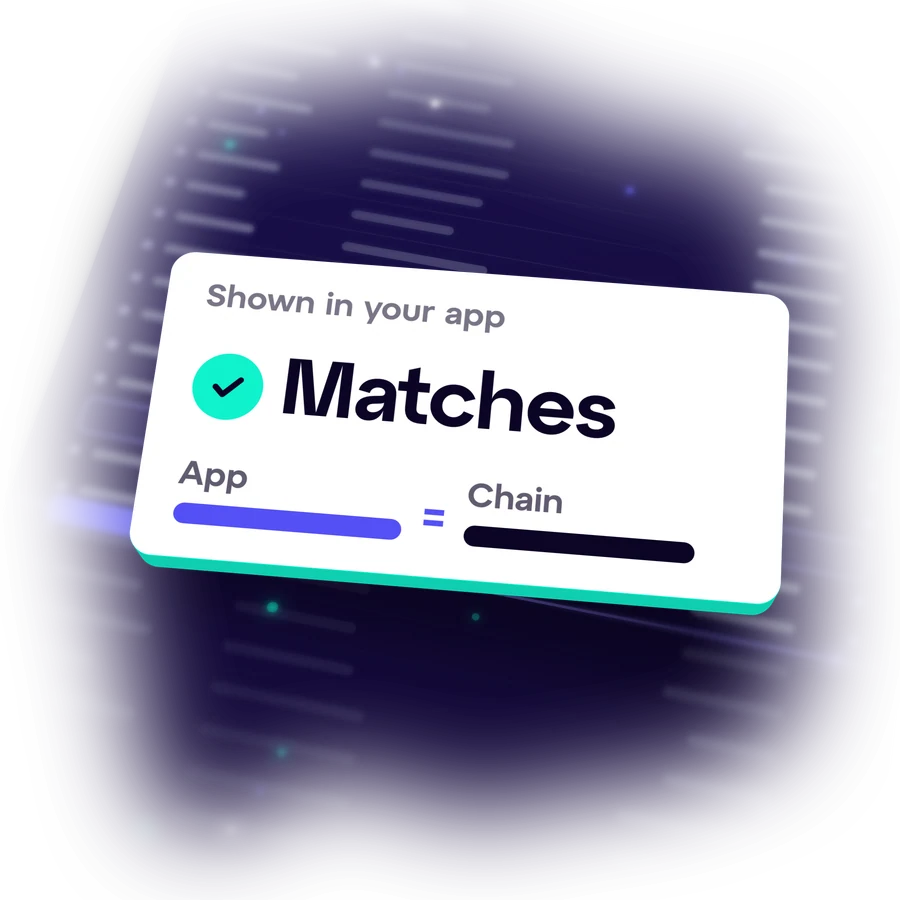
Your app shows customers a balance that should match the chain, and your licence file now asks how you know it does.
SonarX supplies high-quality data for 130+ blockchains through a REST API, Kafka streams and warehouse shares. You stop running nodes and per-chain indexers, and nothing new has to be built to receive the data.
At a glance
- Decision it supports
- Whether the balance your app shows, and the one in your safeguarding file, ties to the chain at cut-off.
- Available now
- REST API balances on 21 EVM chains and Solana, Kafka streams of live transfers, point-in-time and daily balances, wallet-level transfers and alerts, Labels, and full transaction, trace and bridge history across 130+ chains. With a Snowflake share, Snowflake's MCP support and Cortex work on the tables under your own roles.
- By request
- Decoding of contracts you name, and chains not yet covered.
The pipeline behind every balance in your app
Customers hold funds in wallets on Ethereum, Solana, Base and Polygon, and product wants the next chain this quarter. Every chain adds a node to babysit, a decoder to maintain and a reconciliation job that breaks on a reorg.
Meanwhile the licence application asks how customer funds are reconciled each day. Finance wants balances at cut-off that tie to the ledger. The fraud team wants history to train on. Each request lands on the same small data team.
What SonarX takes off your engineering roadmap
Balances and history behind one API
The REST API returns point-in-time balances on 21 EVM chains and Solana, plus blocks, transactions, logs, traces and transfers. Shares and files carry all 130+ chains in the same schema.
One schema across 130+ chains
A new chain arrives in the layout your services already parse. Contract decoding requests are free, and a missing chain can be requested.
Deposits and withdrawals as a stream
Kafka streams deliver live transfers to your ledger services. Shares hold the full history for finance, in the same fields.
Balances your finance team can close on
EVM balances by block, Solana by snapshot, and daily balance tables, reproducible for the auditor.
Customer data stays with you
Joins with customer records and KYC data happen in your environment. SonarX never sees your queries.
How fintechs and wallet apps use SonarX
- Reconcile deposits, withdrawals and payoutsMost teams start here
- Evidence balances for safeguarding and the licence file
- Serve balances and history inside the app
- Retire the per-chain indexers
- Work FIU cases across chains
- Catch bots farming your promotions
- Send customers statements they can file
Most teams start with: Reconcile deposits, withdrawals and payouts, Evidence balances for safeguarding and the licence file and Serve balances and history inside the app.
Most teams start here
Tie every customer movement on every chain to the app's ledger.
- Today
- Each chain has its own reconciliation script, and failed transfers surface through support tickets.
- With SonarX
- Transfers and balances per omnibus and customer wallet, with stream alerts on failed and large transfers.
- You get
- A daily reconciliation file and a live exception feed.
Show what each wallet held at cut-off, and show it again for the auditor.
- Today
- Engineers query nodes at month end and hope nothing reorganized.
- With SonarX
- Point-in-time balances with the transfers behind them, reproducible later.
- You get
- Cut-off balances for safeguarding reports and audit.
Show customers accurate balances, token holdings and activity on every chain you support.
- Today
- The app depends on self-run nodes and third-party RPC endpoints with different formats.
- With SonarX
- One REST API for balances and transactions on the chains it serves, and Kafka for live updates.
- You get
- One integration in place of a node per chain.
Add chains without growing the data engineering team.
- Today
- Every new chain is a quarter of pipeline work.
- With SonarX
- Decoded, normalized data for 130+ chains in your warehouse, with the API and Kafka for live paths.
- You get
- Engineers back on product work.
Trace customer funds through bridges for an investigation or a law-enforcement request.
- Today
- Analysts copy addresses between explorers.
- With SonarX
- Full transaction, trace and bridge history, with labels for the entities you name.
- You get
- The record your investigators and forensics partner work from.
Stop sybil wallets claiming rewards meant for real customers.
- Today
- Fraud rules fire on obvious patterns and miss the clusters.
- With SonarX
- Transaction-level history to train your models, and behavioural clustering scoped with the SonarX team for your campaign.
- You get
- Training data and wallet clusters for your fraud models.
Give each user a statement or tax-year activity report.
- Today
- Statements are built from internal tables that miss on-chain activity outside the app.
- With SonarX
- Standardized wallet balances and activity per customer wallet, shaped for your templates.
- You get
- Balance and activity schedules per wallet.
Most teams start with: Reconcile deposits, withdrawals and payouts, Evidence balances for safeguarding and the licence file and Serve balances and history inside the app.
One-week trial
Prove it in your one-week trial
Pick an omnibus wallet, pull one day of its deposits and withdrawals from SonarX, and compare them line by line with your app's ledger for that day.
Choose a past cut-off, query each test wallet's balance at that block, and compare it with a public explorer and your safeguarding records.
Call the REST API for a set of customer wallets on two chains you support, then compare the balances with what your app displays for the same wallets.
How it arrives
Ways to receive the data
- API and streams
- REST for balances and history; Kafka for live transfers.
- Warehouse
- Snowflake Secure Data Sharing, Databricks Delta Sharing, or a managed Reader account with no warehouse of your own.
- Files
- Parquet, CSV or Iceberg into S3, Google Cloud Storage or Azure.
Trust
SonarX holds SOC 2 Type I and II and is GDPR compliant, with enterprise agreements covering all customer data. See the Trust Center.
Fintech FAQ
Can we build on SonarX without our own warehouse?
Yes. The REST API and Kafka streams serve your application directly, and a managed Reader account gives analysts a SQL workspace with no warehouse of your own. Files in your bucket feed a lake if you run one. Pick the path that matches each team.
Can SonarX data be used for Compliance purposes?
Yes. SonarX supplies provenance, flows, balances and labels on request, and several compliance vendors build their screening on that data. Keep your screening vendor and feed it a complete multi-chain record.
Can we reconcile SonarX data against our ledger and KYC records?
Yes, inside your own environment. Shares and files land in your warehouse or lake, where you join customer accounts, KYC records and the ledger. SonarX supplies the on-chain half and never sees your queries or your customer data. Your matching rules stay yours.
How are new chains added?
SonarX covers 130+ chains as of October 2026, all in one schema. If your roadmap needs a chain that is not covered, ask through Request a Chain. Contract decoding requests for tokens on covered chains are free and go through the standard channel.
How much does it cost, and can we test first?
SonarX sells enterprise plans. Qualified teams get a one-week trial on a share, a Reader account or Kafka, and a trial on the API at one request per second. The SonarX team scopes the trial to the chains your product supports.
Test it on your own chains
Delivered through Instant Datashares, Kafka Streaming, the Realtime API, Balances and Curated Datasets.