
Customers · Custodians
On-chain data for digital-asset custodians
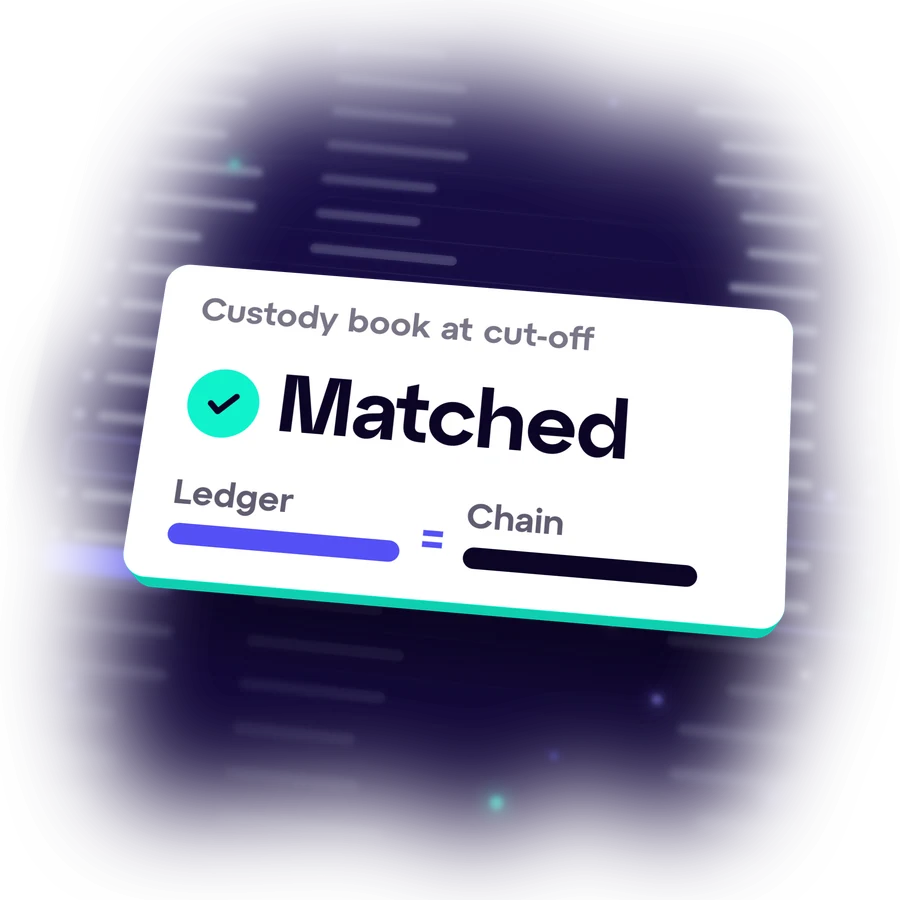
Your custody ledger is only as good as its match to the chain: every address, every cut-off, every network you support.
SonarX keeps a complete, reorg-aware copy of 130+ blockchains and delivers it into your warehouse, your bucket or your reconciliation engine. You run no nodes and build no indexers. Receiving the data takes no new infrastructure either.
At a glance
- Decision it supports
- Whether your custody book matches the chain for every address and cut-off, with evidence your auditor and examiner can rerun.
- Available now
- Point-in-time balances and transfer history for every custody address, priced transfers, roll-forwards and fair-value tables, labels, staking rewards earned and claimed per delegation on 10+ chains, per-chain supply with every mint and burn, and point-in-time balances by REST API.
- By request
- Decoding of contracts you name, and chains not yet covered.
The second ledger you reconcile every day
Each client balance has to match the chain at a point in time, intraday when the client settles off-exchange. Staking rewards credited to clients have to match what validators earned. If you hold reserves for a stablecoin, or issue one, mint and burn have to match the report.
Internal audit, the external auditor and the examiner all want that evidence from an independent source, reproducible months later. What breaks the job is breadth: dozens of chains, staking on many of them, and tokenized funds on networks your engineers have never touched.
What SonarX adds to your custody stack
A record you did not build
SonarX operates the chain data, from genesis to tip, with reorg handling and a data quality framework that checks completeness and integrity on every chain. Your evidence does not depend on your own nodes.
Every address at any block
Balances by block height on EVM chains, by snapshot on Solana, daily balance tables and state diffs for any record date. Each balance comes with the transfers behind it.
Staking that ties out
Delegations, rewards earned and rewards claimed, commissions, slashing and validator performance on 10+ proof-of-stake chains, refreshed daily.
One schema for 130+ chains
A new custody chain lands in the layout your reconciliation already reads. Contract decoding requests are free, and a missing chain can be requested.
Delivered where reconciliation runs
Shares for finance and audit, a REST API for point-in-time balances and Kafka streams for live records. SonarX never sees your queries.
How custodians use SonarX
Show what each address held at the reporting date, and show it again next year.
- Today
- Operations samples addresses on public explorers and attaches screenshots to the file.
- With SonarX
- Query every custody address on every chain at the exact block or snapshot, with full history.
- You get
- Point-in-time balances and transfer history your auditor and examiner can rerun.
Close the day with zero unexplained breaks, valued for finance.
- Today
- A break on a long-tail chain sits open for days because nobody can see the chain side.
- With SonarX
- Transfers priced at transaction time, roll-forwards and fair-value tables beside raw balances, joined to your ledger in your warehouse.
- You get
- A break you find in one query.
Credit clients exactly what their stake earned.
- Today
- Validator dashboards, the staking provider's report and the ledger give three numbers.
- With SonarX
- Rewards earned against rewards claimed per delegation, plus validator APR, commissions and net stake flows.
- You get
- A staking ledger per client position and a view of each validator you delegate to.
Match per-chain mint, burn and supply to the coin's monthly report.
- Today
- Supply is summed from explorers, chain by chain, and bridge escrows confuse the total.
- With SonarX
- Circulating supply, mint and burn events and holder balances per chain, daily and at month end.
- You get
- The on-chain side of the report, in one table.
Keep the holder register of a tokenized fund correct on each network it lives on.
- Today
- The register is rebuilt from transfer logs before each record date.
- With SonarX
- Holder balances, transfers and record-date snapshots per network.
- You get
- Address-level registers. Holder identity stays with you.
Add a custody chain without adding a pipeline.
- Today
- Each new chain means a node, a decoder and an on-call rotation.
- With SonarX
- Point-in-time balances by REST API, live transfers by Kafka, history by share, all in one schema.
- You get
- One integration across chains, with no node per chain to run.
Give clients a statement their own auditor accepts.
- Today
- Statements are assembled from custody exports and break when a price is restated.
- With SonarX
- Standardized wallet balances and activity, shaped for statements and delivered as files for your templates.
- You get
- Balance and activity schedules per client wallet, reproducible for any past period.
One-week trial
Prove it in your one-week trial
Pick custody addresses on the chains you support and a past cut-off, query their balances at that block or snapshot, and compare them to your custody ledger.
Choose one delegation and a closed period, pull rewards earned and claimed, and compare them to the staking provider's report and to what you credited the client.
Call the REST API for a custody address balance at a past block and compare it to the same figure from the warehouse share and from your ledger.
How it arrives
How the data arrives
- Warehouse
- Snowflake Secure Data Sharing, Databricks Delta Sharing, or a managed Reader account with SQL and no warehouse of your own.
- Files
- Parquet, CSV or Iceberg to S3, Google Cloud Storage or Azure.
- Live
- REST API for point-in-time balances; Kafka streams for live records.
- Resilience
- Cross-region disaster recovery (US East 2) can be added under the enterprise agreement.
Trust
SonarX holds SOC 2 Type I and II and is GDPR compliant. Enterprise agreements cover all customer data. See the Trust Center.
Custody teams ask
Is SonarX an independent source our auditor can use?
SonarX gives the auditor a query to rerun on data produced outside your systems. Every row ties to its chain source, history runs from genesis and is reorg-aware, and SonarX holds SOC 2 Type I and II. The judgment on evidence standards stays with the auditor, and the data can be shared to them directly.
Which security attestations does SonarX hold?
SonarX holds SOC 2 Type I and II and is GDPR compliant, published in the Trust Center. Enterprise agreements cover all customer data, and in a share SonarX cannot see your queries. Your vendor-risk team can request the reports through the Trust Center before the trial starts.
Can you cover every chain we custody?
SonarX covers 130+ chains as of October 2026, and staking data on 10+ proof-of-stake chains. Send your chain and staking lists before scoping and SonarX will map them against coverage. Contract decoding requests are free, and a missing network goes through Request a Chain.
Can we reconcile against our own custody ledger?
Yes. The data lands in your warehouse, so you join it to the custody ledger, client accounts and statements without moving them out. SonarX supplies the chain side. Your team keeps the mapping of addresses to clients, and the reconciliation logic stays yours.
Can you reconstruct a client's holdings at a past date and value them?
Yes for wallets: balances by block on EVM chains, by snapshot on Solana, and daily balances, with transfers priced at transaction time. Prices are a market-data passthrough, not a reference rate. Valuing DeFi positions and mapping wallets to accounts stay with your team.
How fast can we start?
Qualified teams get a one-week trial on a share, a Reader account or Kafka, and a trial on the API. The SonarX team confirms the chain list with you first, so the trial runs on the networks you custody. A Reader account needs no warehouse of your own.
Test it on your own chains
Delivered through Instant Datashares, Kafka Streaming, the Realtime API, Balances and Curated Datasets.